
Will AI and productivity growth naturally increase leisure time?
Productivity has many measures, but none of them lead to an automatic increase of leisure time for workers. In fact, they are in no way related. You have to fight and win leisure time just as you would wage increases.

Leisure time through increased productivity?
No, AI and productivity will not naturally increase leisure time for workers. Except maybe in the short term through layoffs.
Leisure time is not provided by the "free" market, it is provided when Labour has relatively high power to Capital during times of growth.
Those conditions do not exist globally right now. And, certainly not in the USA.
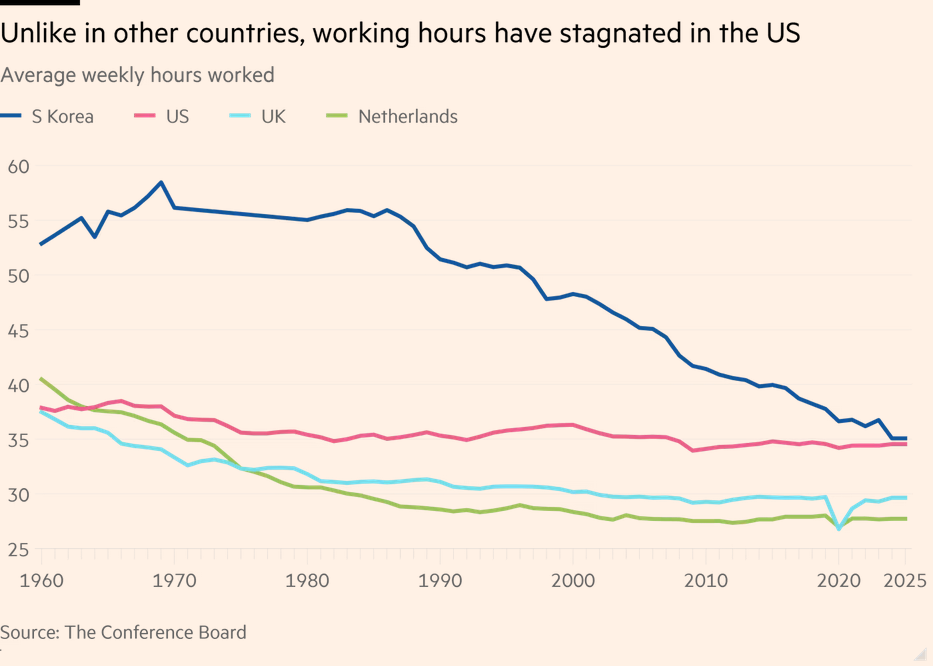
The investment firms and bank CEOs are all in on talking about leisure time from AI investment. It was the talking point from all of them in the previous few weeks.
However, you know it is a lie simply by looking at what these banker CEO's own firms have done with AI implementation. These firms are large enough to actually implement AI/big data algorithms to drive automation.
Did these firms reduce office working hours while increasing pay to increase their worker's leisure time? Or, did they layoff workers and pocket the profits?
You can guess the answer.
Well, if even these highly profitable firms are not going to naturally increase leisure time for workers, then how is leisure time going to grow for workers? Well, obviously it cannot and is not.
And, this conversation is only interesting if AI actually increases "productivity" at the firm level. That's not guaranteed either.
Creative destruction, productivity, and innovation?
In addition to the conversation about how productivity will be good for workers, we have the bizarre "creative destruction" idea that was the recipient of the economics bank funded Nobel-inspired prize given out last week. The prized research is based on some very spurious ideas of neoclassical orthodoxy that have been long rejected by those who do the math.
The main idea of creative destruction is that the physical things investment bubbles create exist after the bubble has popped. Because these things built were real things, unlike the money invested, and therefore bubbles have a positive net benefit to the economy.
The assumptions at play are rather bizarre.
The story is that even as everyone loses money, jobs, and state social programs in the resulting crisis, is good for profitability of the firms left over to run the left-over physical stuff. If this sounds a lot like trickle-up of wealth that leads to "intangible" benefits for everyone through trickle-down, it is because it is the same story.
The concept as told this way is tied-up in this nonsense around productivity, innovation, and the a-historical story of expanded leisure time granted by Western Capitalism. Not through the labour movement coordinating strike action and extracting that labour time in a class conflict, but through natural progress and shared wealth creation.
Classical economists showed why the entire basis for these neoclassical conversations about productivity, economic crisis, and leisure time are unhinged long ago. But, that doesn't stop the orthodoxy congratulating themselves, indeed it means that they must double down.
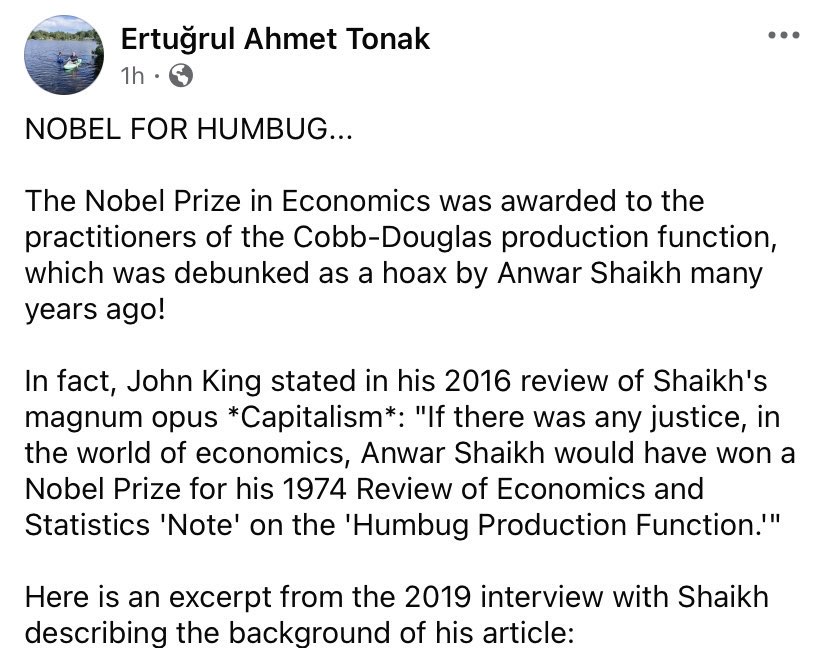
- A link to the Humbug Production Function interview referred to above.
It is this ideological attachment to the Cobb-Douglas Production Function that even drives Statistics Canada's breakdown of productivity, especially what they call Total Factor Productivity (which is just another name for "Multi-Factor Productivity").
In Canada, we are told that this number is incredibly important to our economic growth, even though there is no indication of the causative connection between the two.
Bank economists use TPF in many "macro" calculations, policy analysis, and the government uses it for budget calculations.
It is at the centre of our policy on growth and government investment and the Liberal government's innovation policy.
It comes up in every conversation when capital complains about low levels of technological change and implementation in Canada as if it is describing something that could be good for workers. Low growth of TFP is blamed for Canada's low level of "economic dynamism".
The left (even me) refer to it occasionally as short-hand for innovation when trying to talk to neoclassical/neoliberal policy folks about government investment in research and development.
Unfortunately, it is neoclassical nonsense and has no basis in any reality.
The metrics and the statistics it is dependent on were fully discredited by the classical economists (Anwar Shaikh, specifically) in the 1970s as junk science and should have been thrown out along with wage-price spirals and the Phillips Curve.
Strangely, it is even common knowledge of orthodox economists that look at productivity that so-called "Multi-Factor Productivity" amounts to ascribing a measure of error to some level of "innovation". Talk to folks who have gone beyond second year economics and it is generally known as a spurious measure of anything specific.
But, here we are giving a Nobel to people doing work on it.