
Why is the federal government obsessed with capital spending?
Reclassifying profit subsidies as capital spending might be fun, but it is not serious policy and it will not result in the investment Canadians need.

Federal budgets and spending
The point of the announcement on Modernizing Canada’s Budgeting Approach was to establish a propaganda program supporting Carney's view of the economy inside the Department of Finance.
It does nothing else.
Carney's Liberals are about "reducing spending and increasing investment." Of course, that is much harder to do than say, so instead of doing that the government is reclassifying existing numbers as different things to fit that new narrative.
It knows it is a propaganda program and admits as much by stating clearly that existing accounting norms will still be adhered to. This "New Approach to Budgeting" will be an additional document.
Canada already separates operations from infrastructure/capital spending in the budget. In fact, it is reported based on spending per project and there are many ways to group those spending.
What Carney is doing is lumping in "profit subsidies" that are ongoing (basically operations) in with capital spend to make it look like the government is actually building something.
They have always sort of done this, mostly through P3s. So, this is little different from that.
Some have suggested that this is a deviation from neoclassical orthodoxy, but it is not.
Classical economics would say you should separate the economy into productive and nonproductive spending, not capital and operations. Operations include services many of which are capital intensive. And, a lot of supposed "capital spending" turns out to be non-producing. If "capital" is non-producing, is it really Capital? No, it isn't.
So, why do all this beyond propaganda? Well, the banking sector has sort of backed itself into a corner. Looking through some large volatility, business investment in Canada has not been growing recently and has been flat since the financial crisis. This is shown in the graph in the link above comparing investment in Canada and the USA.
I do not know why Canada would ever really compare ourselves to the USA on this measure. Our economy is nothing like the Americans and have not got a free money flow to the military and domestic industrial capacity.
The USA has had "capital investment" because it is massive and has provided significantly larger investment subsidies. First around climate change, then covid supports, then post-covid supports, then AI. Now it is AI, defence, and Trump's folks giving money to themselves and their friends.
Current growth in "private" (read: government subsidized private) capital investment is in AI-related expansion, which is the only thing in the private sector that is expanding in the USA. Obviously that is spending on data centres and energy to power them. Hardly something that Canada can sustain relative to the USA given our tiny population and the overt trade war we are in. So, it is especially nonsensical to compare things that way right now.
The biggest critique I have is that we are going to reclassify Canadian profit subsidies (including R&D and Canadian Investment Bank cheap loans) as capital investment. That's a big fudge because just because we give money to private capital who promise to build stuff, doesn't mean that they are going to actually build anything productive.
To me, this looks like "ongoing operations spending," not "Captial" spending
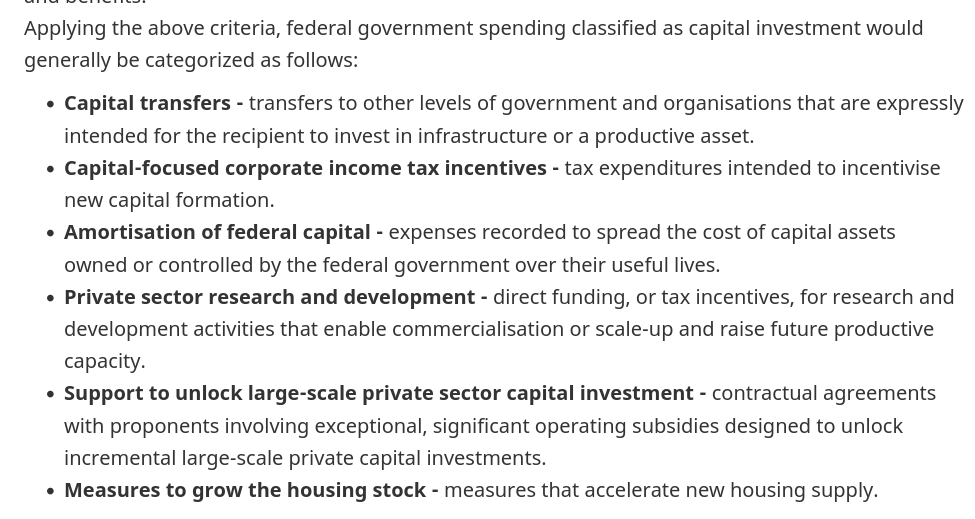
R&D is capital spending? Like, since when?
I don't usually cite things from strongly neoclassical publications, but even this page from Investopedia shows how nonsensical the restructuring of some of that money as "capital" spending is just propaganda:
Research and development (R&D) expenses are associated with creating new products or services, and a company may deduct them on its tax return.
In some cases, costs associated with R&D activities can be capitalized and reported on the balance sheet. When these costs are capitalized, the expense is recognized as an asset and full recognition of expenses is delayed. This is more favorable to companies and makes their financials look better.
Examples of when R&D costs may able to be capitalized include:
- Intangible assets acquired through acquisitions.
- When the costs create materials, fixed assets, or other assets that have an estimable value and useful life.
- Software that can be converted or applied elsewhere in the company to have a useful life beyond a specific single R&D project.
So, unless the NRC is going to start buying companies, commercializing current technology, or expanding operations capacity to support production of products for companies, it isn't capital spending.
Along with this is the moving of dates of publication which is mostly irrelevant. It doesn't change how much is being spent if you report later in the year, but it does shift the make-up of what is announced as "capital" under this new rubric and what actually goes out the door as productive investment.